TL;DR
- People Operations (People Ops) is a strategic, data-driven evolution of traditional HR, centered on employee experience, culture, and business outcomes rather than only compliance and administration.
- Companies with dedicated PeopleOps functions report 78% stronger retention rates than organizations using more traditional HR models.
- Modern PeopleOps typically covers talent acquisition, performance management, compensation strategy, culture, organizational design, and people analytics.
- The most effective tech stack includes integrated systems across HRIS, ATS, engagement, and performance rather than disconnected tools.
- For remote and distributed companies, PeopleOps needs to be deliberate about onboarding, async culture, and time zone equity.
- AI, skills-based talent mobility, pay equity, and flexibility are the major trends shaping the field in 2026.
If you’ve spent the last few years in th
If you’ve spent the last few years in the HR world, you’ve probably noticed something shifting. The language has changed. The role has evolved. Where we once talked about “Human Resources” managing administrative tasks and compliance, we now talk about People Operations orchestrating culture, strategy, and employee experience.
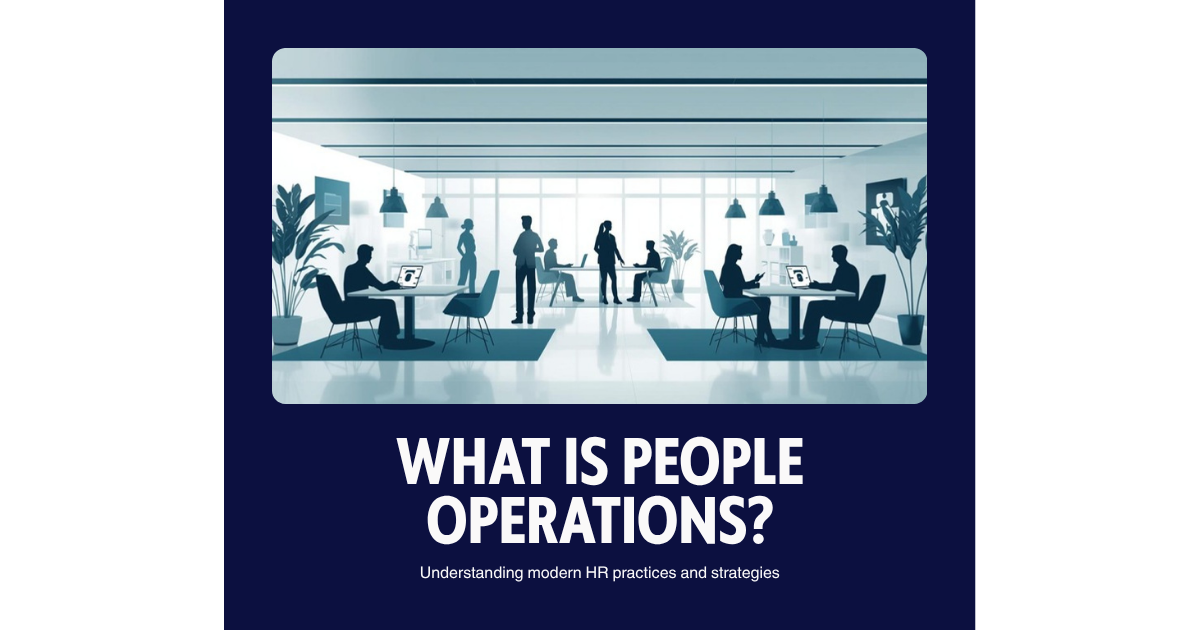
What is People Operations? People Operations (People Ops) is a data-driven, employee-centric approach to managing the workforce that evolved from traditional Human Resources. While HR historically focused on compliance, policies, and administrative tasks, People Ops takes a strategic approach — using technology, analytics, and design thinking to improve the entire employee experience from hiring through offboarding.
In 2026, the answer is straightforward: companies that embrace People Operations as a strategic function are outpacing those clinging to outdated HR models. They’re moving faster, retaining talent better, and building cultures that attract the best people in competitive markets.
This guide walks you through everything you need to know about People Operations — from its fundamental definition to building your own function from scratch.
People Operations vs. Traditional HR: What’s the Difference?
Traditional HR has historically focused on compliance, payroll, benefits administration, and hiring. It’s reactive. Someone gets sick? Process their leave form. Someone leaves? Post the job. Someone breaks a rule? Document it. These are necessary functions, but they’re often viewed as cost centers.
People Operations flips this orientation entirely. Instead of managing problems after they occur, PeopleOps is fundamentally strategic. It’s the function responsible for ensuring that people — your organization’s greatest asset — are optimized, engaged, and aligned with company goals.
Here are the core differences:
Orientation and mindset Traditional HR is compliance-first, defensive, and risk-averse. The goal is often to avoid legal problems and manage exceptions. People Operations is strategy-first, proactive, and growth-oriented. The goal is to use people practices to drive business outcomes.
Decision-making Traditional HR makes decisions based on precedent, policy, and legal requirements. “We’ve always done it this way” is a common refrain. People Operations makes decisions that are data-driven and outcome-focused. If a policy doesn’t serve your culture or business goals, it changes.
Who it serves Traditional HR often serves the company’s legal and compliance interests, which aren’t always aligned with employee interests. People Operations serves the employee experience while also driving business results. The best PeopleOps leaders understand these aren’t mutually exclusive.
Technology approach In traditional HR, systems are used primarily for record-keeping and payroll processing — technology is tactical. In People Operations, technology is a strategic enabler. PeopleOps teams build integrated systems that provide insights into engagement, performance, and organizational health.
The bottom line: traditional HR manages what already exists. People Operations shapes what comes next.
The Evolution of People Operations: How We Got Here
People Operations isn’t entirely new — it’s an evolution of something that’s been brewing for the last 15 years.
In the early 2010s, tech companies like Google, Netflix, and Airbnb were growing so fast they broke traditional HR models. You couldn’t hire 10,000 people a year using forms and spreadsheets. You couldn’t build culture if you didn’t obsessively measure and improve your employee experience. These companies needed a fundamentally different approach.
They created roles that blended HR strategy with operational discipline. They hired people with backgrounds in operations, product management, and analytics — not just HR. They applied the same rigor to managing people as they did to managing code or infrastructure.
By the mid-2010s, every fast-growing company was trying to replicate this model. By the late 2010s, “People Operations” became a legitimate function, even in non-tech industries.
Then the pandemic accelerated everything. In 2020, companies that had invested in distributed workforce strategies survived remote work. Companies with strong employee engagement practices retained talent when everything went chaotic. Companies with transparent communication frameworks moved faster than competitors. PeopleOps became undeniably strategic.
Today, in 2026, the question isn’t whether you need People Operations — it’s how sophisticated your function is. According to research from the HR Technology sector, 78% of organizations with dedicated PeopleOps functions report significantly stronger retention rates compared to those with traditional HR structures. The data is clear: this model works.
Core Responsibilities of a Modern People Operations Team
Talent acquisition and onboarding PeopleOps owns the end-to-end candidate experience, from job description to the first day. This includes defining what makes a great hire for your culture, streamlining the interview process, and ensuring new employees integrate quickly. Modern PeopleOps teams measure time-to-hire, quality of hire (by performance ratings and retention), cost per hire, and hiring manager satisfaction to drive continuous improvement.
Compensation and benefits strategy Your compensation philosophy should directly support your company’s values and hiring strategy. Are you competing on salary or flexibility? On title growth or impact? On health benefits or unlimited PTO? PeopleOps teams benchmark compensation, conduct pay equity analyses, model the financial impact of benefits decisions, and ensure pay practices align with company strategy.
Performance management and development This is where PeopleOps diverges most dramatically from traditional HR. Instead of annual reviews — a practice most high-performing companies have abandoned — modern PeopleOps functions implement continuous feedback systems, regular 1:1s, skills mapping, and career pathing. Research shows that companies with continuous feedback systems have 14% lower turnover than those using traditional annual review cycles.
Culture and employee experience PeopleOps shapes how it feels to work at your company — from communication practices to how conflict is handled. It’s not HR planning the holiday party. It’s PeopleOps intentionally designing every touchpoint to reinforce your values and keep people engaged.
Organizational design and planning As companies grow, structure matters enormously. PeopleOps helps leaders think through how teams should be organized, the right ratio of managers to individual contributors, where to centralize vs. decentralize, and how structure supports strategy. This requires understanding your business deeply — the opposite of a siloed HR function.
Data and analytics PeopleOps should be the most data-driven function in your organization. You track hiring metrics, engagement scores, retention rates, promotion rates, pay equity metrics, and learning completion rates. The best PeopleOps leaders can answer: which interview questions best predict performance? What’s the correlation between remote work and retention? Are we promoting equitably? If you can’t answer these, your data infrastructure isn’t mature.
Compliance and policy You still need to comply with employment law, manage benefits administration, and handle regulatory requirements. The difference: in a PeopleOps context, this is efficient and automated where possible — never the centerpiece of strategy.
The People Operations Tech Stack: Tools for Modern Teams
HRIS (Human Resource Information System) This is your backbone. It stores employee data, manages org charts, handles benefits administration, and integrates with payroll. Modern options like BambooHR, Guidepoint, and Workday serve mid-market and enterprise companies.
Applicant Tracking System (ATS) Your recruiting engine. The best systems let you source candidates, manage pipelines, schedule interviews, and collect interviewer feedback — without endless back-and-forth emails.
Engagement and surveys Tools like Culture Amp, Glint, or Officevibe measure employee engagement through pulse surveys and surface actionable insights into what’s working and what’s not.
Performance management Systems like 15Five, Lattice, or Dayforce facilitate continuous feedback, goal tracking, and development conversations. They’re built for real-time feedback — not annual reviews.
Learning and development Platforms like Coursera, LinkedIn Learning, or Succession support employee growth. The best ones integrate with your HRIS so you can track learning and correlate it with performance.
Benefits administration Tools like Justworks, BenefitsCafe, or Rippling streamline enrollment, manage documentation, and help employees understand their benefits.
Communication and community Especially for distributed teams, you need tools that build connection — Slack for async communication, Gather or Teamflow for virtual coworking, or internal newsletters for company-wide updates.
The key principle: your tech stack should integrate. Siloed systems create friction and block the data insights that drive strategy.
People Operations Metrics: How to Measure Success
Recruitment metrics
- Time-to-hire: Industry average is 36–42 days; fast-growing companies aim for 20–25.
- Cost-per-hire: Ranges from $2,000–$5,000 depending on role level.
- Quality of hire: Measured by 1-year retention rate and performance ratings.
Retention metrics
- Annual turnover rate: 10–15% across most industries; 15–20% for software engineers in competitive markets.
- Regrettable vs. unregrettable turnover: An underperformer leaving is a win. A high performer leaving is a problem.
- Retention by cohort: If everyone hired in Q1 2024 left by Q1 2025, something is broken.
Engagement and culture metrics
- eNPS (Employee Net Promoter Score): Measured on a 0–10 scale. A score above 50 is excellent.
- Engagement score: Track monthly or quarterly via pulse surveys.
- Manager effectiveness: Managers directly drive retention — survey employees on theirs regularly.
Development metrics
- Internal promotion rate: High internal promotion indicates strong development pipelines.
- Learning hours per employee: Track average hours spent on learning and development.
Compensation metrics
- Pay equity: Analyze pay by gender, race, and other dimensions — increasingly required by regulation.
- Compensation competitiveness: Benchmark against market using tools like Radford, Equifax, or Mercer.
The best PeopleOps teams report quarterly on these metrics and present them alongside financial data. If your CEO doesn’t see people metrics next to revenue numbers, PeopleOps isn’t being treated as strategic.
Building Your People Operations Team: A Practical Guide
At 30–50 employees (minimum viable team) You need one full-time person handling recruiting, onboarding, and foundational culture work. An HR background isn’t required — operational discipline and business sense matter more at this stage.
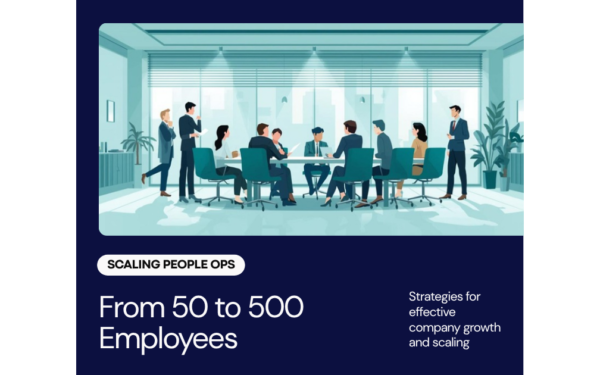
At 50–200 employees (scaling stage) Divide responsibilities across a Head of People Operations (strategy and leadership), a dedicated recruiter, and a People Operations coordinator for benefits, onboarding, and logistics.
At 200+ employees (mature function) You can now specialize, with separate leaders for talent acquisition, employee experience and culture, learning and development, compensation and benefits, and people analytics.
What to look for when hiring PeopleOps leaders The best PeopleOps hires share five traits: business acumen (they connect people strategy to revenue), operational excellence (they build systems and processes), data literacy (comfortable with spreadsheets and basic statistics), empathy paired with directness (they care about people but have hard conversations), and genuine curiosity (they follow industry research and constantly ask why). Many of the strongest PeopleOps hires come from operations, product, or engineering — not traditional HR. It’s about capability, not credentials.
People Operations for Remote and Distributed Companies
The shift to distributed work has fundamentally changed what People Operations means. Companies without physical offices can’t build culture through proximity. They have to be intentional about it.
Remote-first hiring You can hire the best person anywhere, but you need structured interviews, work samples, and extended onboarding to assess fit without in-person contact. Asynchronous video interviews often work better than synchronous calls — they reduce time zone friction and give candidates thinking time.
Distributed onboarding The first 30 days are make-or-break. New hires need clear written documentation, a structured onboarding buddy, regular manager check-ins, virtual social time with teammates, and explicit clarity on communication norms — when is real-time expected vs. async? Companies that nail this see stronger early retention and faster ramp-to-productivity.
Asynchronous culture building You can’t gather everyone in a room, so culture is built differently — through mission clarity, values-driven decision-making, and intentional communication. Some companies use async video messages from leadership. Others create internal culture channels where stories and values are shared. The best ones treat meetings as asynchronous first, synchronous second.
Time zone challenges If you span time zones, someone is always offline. Address this by defining core overlap hours, recording important meetings for async viewing, rotating meeting times so the burden doesn’t always fall on the same people, and defaulting to written communication over real-time chat. Remote doesn’t mean disconnected — it means being more intentional about connection.
Emerging Trends in People Operations (2026 and Beyond)
AI and predictive analytics AI is influencing PeopleOps in meaningful ways — predictive attrition modeling, resume screening, and skill matching. The best PeopleOps teams are implementing AI thoughtfully, with transparency about how algorithms influence decisions.
Skills-based talent movement Traditional career ladders are giving way to skills-based mobility. Someone might move from engineering to product to operations, building broader capability. PeopleOps teams are mapping skills, not just titles.
Equity and belonging This has moved beyond a checkbox. Leading companies measure belonging by demographic group, conduct regular pay equity audits, and tie executive compensation to DEI outcomes. It’s a business imperative, not just an ethics one.
Flexibility as a competitive advantage Remote work, flexible hours, sabbaticals, internal job changes, and part-time options are becoming table stakes — not perks. PeopleOps teams are architecting flexible work structures that serve both employees and the business.
Mental health and wellbeing The pandemic normalized conversations about burnout, anxiety, and mental health. Progressive companies are investing in mental health benefits, sustainable work-life policies, and normalized wellbeing conversations. Your benefits should reflect this.
The Future of People Operations: What’s Next
People Operations will become more strategic, not more transactional. Routine processes — benefits enrollment, payroll, compliance documentation — will continue to be automated, while investment increases in organizational design, culture, talent strategy, and analytics.
Data will drive decisions. People decisions will move away from gut feel and toward evidence. The PeopleOps leader who can say “based on our engagement scores and exit interviews, here’s what we should do” will have far more influence than one saying “I think we should…”
Speed will matter more than perfection. The pace of business change means you can’t spend six months rolling out a new performance system. Fast experimentation and iteration will be the norm.
Integration will be essential. Your PeopleOps strategy can’t live in isolation from engineering, product, finance, or operations. The best companies have PeopleOps deeply embedded in business strategy — not sitting beside it.
HR Operations: The Complete Guide to Running an Efficient People Function
HR Strategy: How to Build a People-First Plan That Drives Results
Scaling People Ops Past 100 Employees
Building an HR Technology Stack for Remote Teams
SHRM: The Rise of People Operations
Gallup: State of the Global Workplace Report
McKinsey: People & Organizational Performance Insights
Bureau of Labor Statistics: HR Managers Outlook
Harvard Business Review: Human Resource Management
Frequently Asked Questions
FAQ: People Operations
What is the difference between People Operations and HR?
Traditional HR is typically reactive and compliance-focused, handling forms, exceptions, and legal risk. People Operations is more proactive and strategic, using data, technology, and design thinking to improve employee experience and support business outcomes. The key shift is moving from treating people as a cost to manage toward seeing them as an asset to develop.
When should a company hire its first People Ops person?
Usually around 30-50 employees. At that point, one full-time person can often manage recruiting, onboarding, and early culture-building efforts. That person does not always need a traditional HR background; operational discipline and strong business judgment can matter even more at this stage.
What metrics should a People Ops team track?
Core metrics include time-to-hire, cost-per-hire, quality of hire, annual turnover, eNPS (Employee Net Promoter Score), engagement scores, internal promotion rate, and pay equity. The strongest PeopleOps teams review these metrics alongside financial performance during quarterly leadership meetings.
How does People Operations work differently for remote companies, and what tools are essential?
Remote PeopleOps has to be much more intentional because culture does not develop through proximity alone. Priorities usually include structured async onboarding, documentation-first communication, deliberate culture-building across channels, and clear time zone fairness policies. The first 30 days are especially important for long-term retention. At a minimum, most People Ops teams need an HRIS such as BambooHR or Workday, an ATS for recruiting, an engagement survey tool like Culture Amp or Glint, and a performance management platform like Lattice or 15Five. The most important factor is that these tools work together, because siloed systems limit the insights that make PeopleOps strategic.