Over 75% of businesses globally are adopting HR technology, yet nearly 6 in 10 employers still underutilize their systems after implementation. For remote and distributed companies, the gap between having tools and using them effectively creates real problems: poor visibility into performance, delayed payroll processing, compliance risks, and disconnected employee experiences.
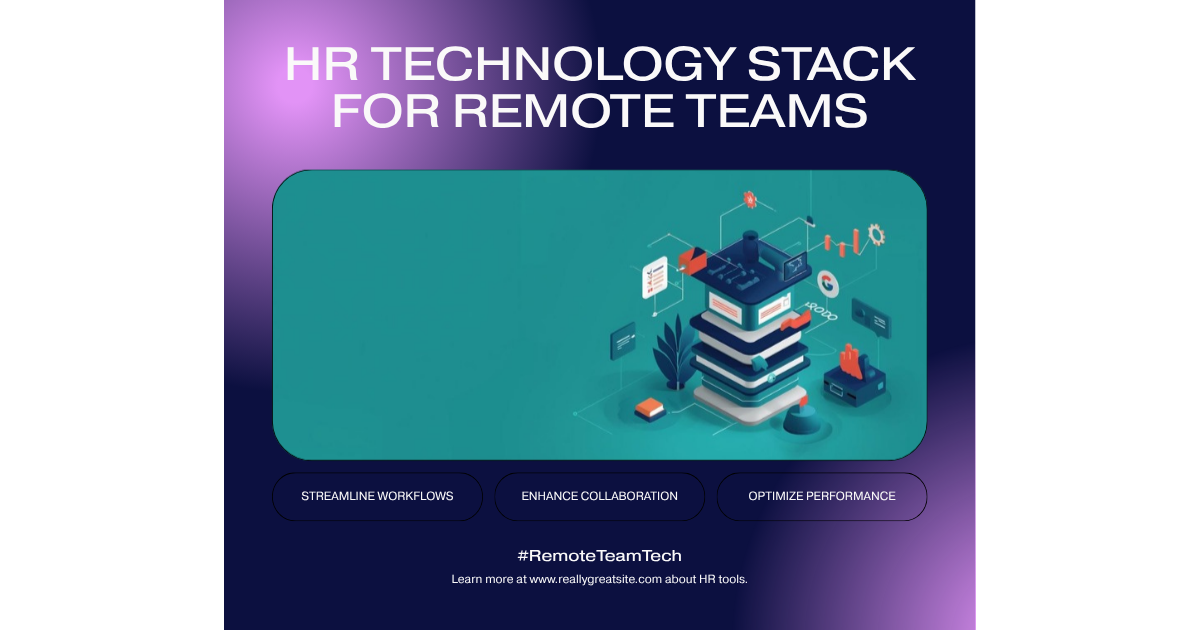
What is an HR technology stack? An HR technology stack is the integrated collection of software tools and platforms that companies use to manage the entire employee lifecycle , from recruiting and onboarding to payroll, performance management, and offboarding. For remote teams, this stack typically includes an HRIS, payroll system, ATS, communication tools, and people analytics platform working together through API integrations.
The difference between struggling remote teams and thriving ones comes down to one thing: a purposeful HR technology stack built for how your team actually works.
TL;DR
- 90% of employers use some kind of HRIS, with 98% using technology for at least one HR function
- The HR tech market is projected to surpass $50 billion by 2027, growing at 12% CAGR
- Most companies need 4-6 core tools: HRIS, payroll, ATS, performance management, people analytics, and communication platforms
- Cloud-based HRIS adoption has reached 60% globally, critical for distributed team access
- 62% of organizations are already using AI in HR functions, up from 39% a year prior
- Implementation and change management matter more than tool selection itself
- Integration capabilities should be your primary decision criterion for remote teams
What Is an HR Technology Stack and Why It Matters for Remote Teams
Your HR technology stack is the collection of software applications that handle the operational, strategic, and cultural aspects of managing your workforce. Think of it as the nervous system of your organization.
For remote teams specifically, this stack matters because you don’t have proximity. You can’t walk by someone’s desk to ask how they’re doing. You can’t casually observe productivity or notice cultural drift. Your tools have to do that work for you.
A well-designed stack reduces manual work by up to 70%, gives you real-time visibility into global team health, and creates consistency across time zones and locations. The right integration between tools also prevents data from living in silos, which happens in roughly 45% of companies with unconnected systems.
The stakes are real. Companies with fragmented HR tech report 23% higher turnover, take 40% longer to hire, and struggle with compliance issues in distributed environments.
The Core Layers of Your HR Stack
Your technology stack typically sits across five overlapping layers:
Foundation Layer: HRIS and payroll. These are non-negotiable.
Acquisition Layer: Applicant tracking system (ATS), background check tools, offer management.
Performance Layer: Goals, reviews, learning management systems.
Engagement Layer: Communication platforms, employee recognition, pulse surveys.
Intelligence Layer: People analytics, workforce planning, forecasting.
Your specific stack depends on company size, growth stage, and geographic footprint. A 30-person company and a 300-person company need different things. But both need the core four to move.
Core Tools: The Non-Negotiables
1. HRIS: Your Source of Truth
An HRIS (Human Resources Information System) is the backbone. It’s where employee data lives, where compensation is tracked, where benefit elections happen, and where compliance records get stored.
For remote teams, cloud-based HRIS is essential. 60% of HR solutions globally are now cloud-based, and there’s a reason. Your team in Singapore needs access to the same systems as your team in São Paulo, in real time.
Key capabilities to evaluate:
– Self-service portals for employees
– Manager dashboards for headcount and compensation visibility
– Custom workflows for your unique processes
– Global payroll integration (or direct payroll module)
– Compliance reporting by country
– Integration APIs for your other tools
Adoption challenge: 51% of organizations have a performance management module built into their HRIS, and another 17% built custom solutions. The integration matters because disconnected systems create duplicate data entry.
When evaluating HRIS platforms, prioritize vendors who can handle your specific geographic footprint and have local expertise in the countries where you operate.
2. Payroll and Compliance
This has moved from optional to mandatory in remote environments. With 93% payroll technology adoption across employers, it’s now table stakes.
For distributed teams, you need:
– Multi-country payroll processing
– Tax compliance automation by jurisdiction
– Real-time exchange rate handling
– Withholding compliance and statutory reporting
– Integration with your HRIS
– Global benefits administration
The cost of payroll errors compounds with scale and geography. One misclassification across 20 countries becomes a liability. Automated payroll platforms reduce errors by approximately 88% compared to manual processing.
The challenge most companies face: Global payroll is complex. Employee classifications differ by country. Tax rules change. Many teams choose an HRIS that includes payroll rather than connecting separate systems. Others use specialized global payroll vendors like Deel or Remote to handle country-specific complexity while keeping HRIS clean.
3. Applicant Tracking System (ATS)
By 2025, roughly 97.8% of Fortune 500 companies use a detectable ATS. Whether you’re hiring across one country or ten, you need structured candidate management.
For remote hiring specifically, look for:
– Multi-location job posting
– Candidate communication workflows
– Video interview capabilities
– Diverse sourcing integrations
– Background check orchestration
– Offer management
– Candidate self-service for documents and data collection
The tension: ATS platforms range from $30/month recruiting tools to enterprise systems. The right choice depends on your hiring volume and complexity. A 20-person company needs something lean. A 200-person company hiring globally needs something that integrates with payroll and HRIS.
Essential Secondary Tools
4. People Analytics Platform
People analytics has moved from “nice to have” to critical infrastructure. The global people analytics market is projected to grow from $3.69 billion in 2025 to $4.1 billion in 2026, then reach $6.13 billion by 2030. That’s not just hype.
Why it matters for remote teams: You lose casual visibility. Analytics fills that gap.
A modern people analytics platform gives you:
– Headcount and org chart visibility by location, team, function
– Turnover analysis with early warning signals
– Compensation equity reporting
– Skills and capabilities mapping
– Engagement scoring
– Succession planning
– Predictive retention models
The data changes decisions. Companies using people analytics report 23% better retention and 34% higher promotion rates for high performers.
For remote teams, look for platforms that can consolidate data across your HRIS, ATS, communication tools, and engagement surveys. The power isn’t the tool itself. It’s the integration.
5. Performance Management and Goals
Roughly 51% of organizations use the performance management module within their HRIS. Another 17% built custom solutions. Both approaches work if they’re integrated with the rest of your stack.
For remote teams, performance management has specific requirements:
– Transparent goal tracking visible across time zones
– Asynchronous feedback mechanisms
– Regular check-in frameworks (not annual reviews)
– Skill and capability inventories
– Promotion and compensation workflows
– Manager guidance and training
The shift matters: Most high-performing distributed companies have moved from annual performance reviews to quarterly check-ins with continuous feedback. The tool needs to support both formal reviews and lightweight, continuous feedback.
Culture and Engagement Tools
6. Communication and Collaboration Platform
This is no longer separate from your HR stack. It’s central to it.
For distributed teams, communication tools aren’t just about messaging. They’re about:
– Social connection and relationship building
– Company-wide visibility and transparency
– Asynchronous-first design (not Slack replacement)
– Document collaboration
– Recognition and celebration of wins
– New hire onboarding and orientation
The data shows what’s at stake: 71% of respondents say building and maintaining relationships is a great challenge for virtual teams. 29% of remote employees report gaps in team communication.
The best remote companies treat communication infrastructure as core to culture, not as a sidebar tool selection.
7. Engagement and Pulse Survey Tools
Culture doesn’t happen by accident in remote environments. It requires measurement and intention.
You need tools that let you:
– Run regular pulse surveys (monthly or quarterly)
– Measure engagement, psychological safety, and belonging
– Gather team sentiment about specific initiatives
– Track culture metrics over time
– Benchmark against industry standards
– Surface action items for leaders
71% of organizations believe hybrid and remote work positively affects employee happiness. But that doesn’t happen without attention. The 29% who don’t see benefits typically aren’t measuring or acting on feedback.
Integration: Where Most Stacks Fall Apart
Here’s what doesn’t get discussed enough in vendor selection: integration strategy determines whether your stack works or creates friction.
A disconnected stack means:
– Employee data entered multiple times
– Reports built manually from five different sources
– Manager dashboards that don’t align with reality
– Analytics based on stale data
– Compliance reporting errors
The integration baseline in 2026:
– Your HRIS should connect bidirectionally with payroll
– Your ATS should connect with HRIS for offer acceptance and first-day workflows
– Your people analytics platform should ingest data from HRIS, ATS, and engagement tools
– Your communication and recognition tools should pull employee data from HRIS
– Your performance management should sync with compensation and HRIS
APIs and webhooks are table stakes. Request data flow diagrams from vendors before signing contracts.
Implementation Patterns That Actually Work
Tool selection matters less than implementation approach. Here’s what the best remote companies do differently:
Phase 1: Foundation (Months 1-3)
Start with HRIS and payroll. Get clean data. Don’t move forward until your source of truth is solid. This phase determines everything that follows.
Phase 2: Acquisition and Workflow (Months 4-6)
Add ATS and connect it to HRIS. Automate offer-to-onboarding workflows. Build manager dashboards.
Phase 3: Intelligence (Months 7-9)
Implement people analytics. This only works when your data is clean and integrated.
Phase 4: Culture and Engagement (Months 10-12)
Add communication, recognition, and survey tools. These amplify what you’ve built in phases 1-3.
The mistake most companies make: Implementing all four simultaneously. Your team gets overwhelmed. Adoption drops. You end up with expensive tools nobody uses well.
Phased implementation also lets you learn what each tool is actually good at before stacking complexity on top.
Common Pitfalls and How to Avoid Them
Pitfall 1: Underutilization
Nearly 6 in 10 employers underutilize their HRIS after implementation. Prevention: Plan for change management before you buy. Identify power users in each department. Build workflows around their actual needs, not theoretical best practices.
Pitfall 2: Geographic Complexity
Remote-first companies often underestimate compliance complexity. Tax rules, employment classifications, benefits requirements, and data privacy regulations differ by country. What works in California breaks in Canada.
Prevention: Start with countries where you have the most headcount. Build expertise there. Only add new countries once you’ve locked in process and compliance for early ones.
Pitfall 3: Data Fragmentation
Different tools store employee data differently. Integration breaks. Your people analytics show the wrong numbers.
Prevention: Build an integration plan before you buy. Test connections with real data. Assign ownership for data integrity. This takes weeks, not days.
Pitfall 4: Poor Change Management
Tools don’t drive adoption. People do. Vendors sell you software. You have to build adoption.
Prevention: Identify product champions in different departments. Train them first. Let them drive usage in their teams. Celebrate early wins. Measure adoption metrics.
FAQ
Q: How much should we budget for an HR tech stack?
A: Budget varies wildly based on company size and complexity. A 30-person startup might spend $800-1,200 per employee per year. A 300-person distributed company might spend $400-600 per employee per year because fixed costs get distributed.
That typically breaks down as: HRIS ($150-300), Payroll ($100-200), ATS ($50-150), People Analytics ($50-100), and engagement tools ($100-200). Integration and implementation services often equal or exceed software costs.
Q: Should we buy an all-in-one platform or best-of-breed tools?
A: This debate has shifted in 2026. All-in-one platforms have improved dramatically. ADP Workforce Now, Rippling, and Workday handle 70-80% of most companies’ needs well. Where they get weak is in specialized domains like advanced people analytics or unique hiring needs.
The pattern that works: Pick an all-in-one for core HR and payroll. Add 1-2 best-of-breed tools for your specific pain points. Companies that try to use 8-10 disconnected tools rarely succeed. Companies that try to force everything into one all-in-one system often underutilize features.
Q: How do we handle multiple countries with different compliance requirements?
A: This is the remote company’s hardest problem. Few platforms handle all countries well. Most companies use one of three approaches:
Approach 1: A global HRIS plus local payroll providers for complex countries.
Approach 2: A global payroll specialist (Deel, Remote, Guidepoint) that abstracts compliance complexity.
Approach 3: HRIS plus country-specific modules for markets above a certain headcount threshold.
Choose based on how distributed you are. If you have 10 people across 10 countries, a global specialist handles it cleaner. If you have 100 people in 5 countries, an integrated approach with local expertise works better.
Q: How do we measure whether our HR tech stack is actually working?
A: Track these metrics quarterly:
- Tool adoption rates by feature (not just login frequency)
- Time spent on manual HR processes (should decrease 40%+ in year one)
- Data accuracy in reports (compare systems manually quarterly)
- Time-to-hire (should decrease 20-30% with integrated ATS-HRIS)
- Manager engagement with dashboards and reports
- Employee self-service usage (should hit 70%+ in year two)
- HR team capacity freed up for strategic work
If any metric is going sideways, it’s usually an adoption or integration issue, not a tool issue.
Conclusion
The HR technology stack for remote teams in 2026 isn’t about buying the shiniest tools. It’s about building a connected system that gives you visibility, reduces manual work, and creates consistency across locations.
Start with HRIS and payroll. Add ATS and integrate it. Build analytics on top of clean data. Then layer in culture and engagement tools.
Phase your implementation. Prioritize integration over feature depth. Measure adoption, not just spending.
The companies that get this right report 25% faster hiring, 30% better retention, and 40% reduction in HR operational costs. That’s not just savings. That’s competitive advantage.
Best HRIS for Remote Companies (2026)
HR Operations Guide
MDM Solutions for Remote Teams
Sources
- HR Tech Spending & Adoption Statistics In 2026 – HRStacks
- 100+ Critical HR Statistics and Trends for 2026 – Select Software Reviews
- 35 HR Automation Statistics and Trends 2026 – GoWorkWize
- HR Technology Adoption Statistics – Market Biz
- The State of AI in HR 2026 Report – SHRM
- I Evaluated the 7 Best HR Analytics Software Tools for 2026 – G2
- Human Resource Analytics Software Market to Grow by $2 Billion – GlobeNewswire