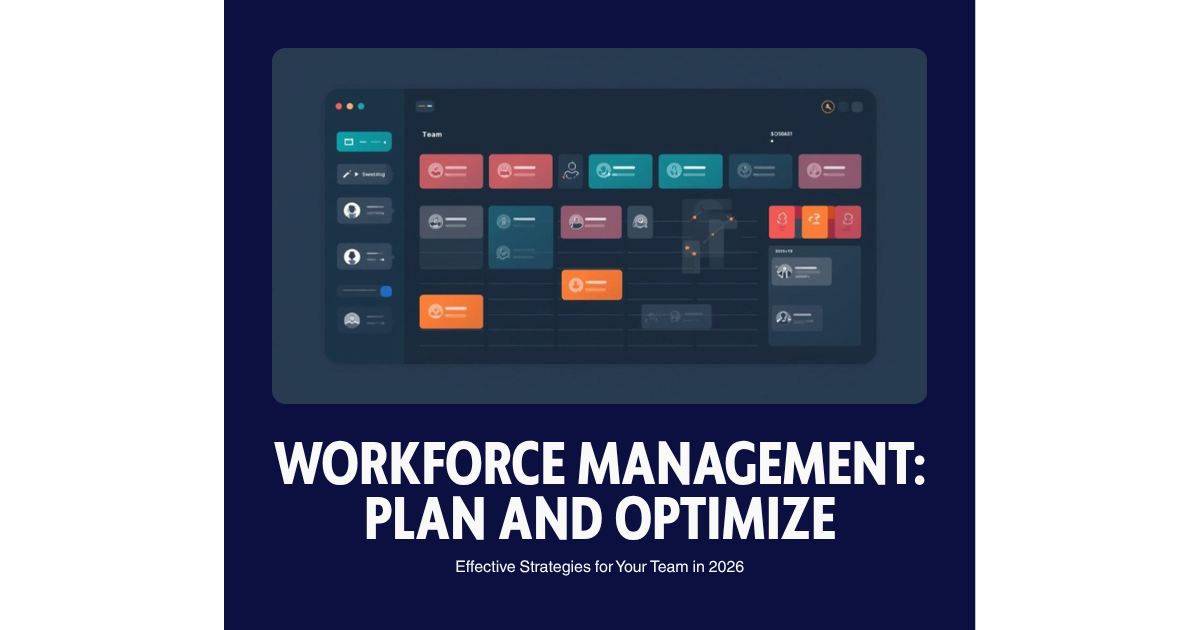
- Workforce management optimizes scheduling, resource allocation, and productivity across your team
- Core components include demand forecasting, scheduling, time tracking, and performance management
- A solid WM strategy reduces labor costs by 10-20% while improving employee satisfaction
- Modern WM tools integrate scheduling, analytics, and compliance monitoring in one platform
- Common challenges include shift coverage, skill mismatches, and burnout prevention
- Data-driven forecasting and transparent scheduling build employee trust and retention
- AI-powered solutions now automate complex scheduling and predict staffing needs
- Implementation requires leadership buy-in, clear processes, and continuous adjustment
What Is Workforce Management?
Workforce management is the set of integrated processes, tools, and strategies that align your labor supply with business demand. At its core, WM ensures you have the right employees with the right skills in the right place at the right time to deliver optimal results.
The discipline combines scheduling, forecasting, compliance, and performance analytics to reduce costs, improve customer service, and boost employee engagement. Unlike traditional scheduling, which simply fills shifts, workforce management treats labor as a strategic asset requiring continuous optimization.
A 2025 Deloitte survey found that 73% of companies with formal workforce management programs report better operational efficiency than those without structured approaches. Organizations implementing WM systems see average improvements in on-time performance, customer satisfaction, and employee retention metrics within six months of deployment.
Core Components of Modern Workforce Management
Effective workforce management rests on five interdependent pillars that work together to create organizational resilience and operational excellence.
Demand Forecasting: This predicts how many employees and what skills you’ll need based on historical data, seasonal trends, and business projections. Accurate forecasting prevents both understaffing (which damages service quality) and overstaffing (which inflates labor costs). Most modern tools use machine learning to improve forecast accuracy quarterly.
Scheduling and Planning: Once demand is forecasted, scheduling assigns specific employees to shifts while respecting labor laws, union agreements, and employee preferences. Smart scheduling considers employee skill levels, availability patterns, and development goals. According to research from the Society for Human Resource Management, effective scheduling reduces overtime costs by 15-25% on average.
Time and Attendance Tracking: This captures when employees work, including clock-ins, breaks, overtime, and absences. Automated tracking reduces time theft and payroll errors while providing data for workforce analytics. Biometric systems, mobile apps, and facial recognition technology now enable real-time accuracy.
Performance and Productivity Monitoring: WM systems measure output against expectations, identifying high performers and productivity bottlenecks. This data informs coaching, staffing decisions, and career development paths. Performance metrics should directly connect to business outcomes and employee goals.
Compliance and Risk Management: Workforce management ensures adherence to labor laws, industry regulations, and internal policies. Automated alerts prevent wage-and-hour violations, unauthorized overtime, and scheduling violations. The complexity of multi-state and international regulations makes this component increasingly critical for growing organizations.
How to Build a Workforce Management Strategy
Building a winning WM strategy requires assessment, planning, and phased implementation across your organization.
Step 1: Audit Your Current State: Document how you currently schedule, track time, forecast demand, and measure productivity. Identify pain points such as frequent schedule changes, high overtime spend, excessive sick leave, or customer service gaps. Interview managers and employees to understand informal processes and resistance points you’ll face during implementation.
Step 2: Define Clear Objectives: Set measurable goals aligned to business priorities. Examples include reducing labor costs by 12%, improving schedule-to-start compliance to 95%, cutting turnover by 8%, or increasing first-contact resolution rates. Specific targets guide technology selection and help you measure ROI after implementation.
Step 3: Select Integrated Technology: Choose a platform that covers forecasting, scheduling, time tracking, and analytics. Integration with your payroll and HR systems is essential. A 2024 Business Intelligence survey showed that companies using integrated WM platforms achieve 40% faster implementation and 3x higher adoption rates than those using separate point solutions.
Step 4: Establish Data Governance: Define who owns scheduling decisions, how forecasts are updated, and who can override automated recommendations. Create a master calendar showing non-work periods (holidays, training, blackout dates) that must be respected across all schedules. Document escalation procedures for schedule conflicts and staffing shortages.
Step 5: Communicate Change: Launch the initiative with clear messaging about why change matters and how it benefits employees. Address concerns about privacy, fairness, and job security directly. Involve employee representatives in design decisions where possible. Companies that invest in change management achieve 60% higher adoption rates than those that simply deploy technology.
Step 6: Monitor and Adjust: Track key metrics monthly and adjust processes quarterly. Most organizations need 3-4 cycles of refinement before WM processes run smoothly. Build in feedback loops allowing managers and employees to raise issues and suggest improvements.
Workforce Planning vs. Workforce Management: Key Differences
While often used interchangeably, workforce planning and workforce management serve different strategic purposes, though both are essential for sustainable growth.
Workforce Planning is the longer-term strategy addressing questions like: What skills will we need in 3-5 years? How should we adjust headcount? What talent gaps exist? Planning typically spans 12-60 months and focuses on organization-wide capability building, succession planning, and strategic hiring. It answers the “what and how many” question.
Workforce Management handles the operational and tactical execution within a 2-week to 6-month timeframe. It answers the “when, where, and how” questions through scheduling, resource allocation, and real-time adjustments. WM ensures daily operations run smoothly based on plans established through workforce planning.
The relationship is hierarchical: strategic workforce planning determines your target structure and skill profile, then workforce management executes that plan through tactical scheduling and optimization. A construction firm might plan to hire 20 electricians over the next 18 months (planning), then use WM to schedule those electricians across active job sites to maximize utilization and meet project deadlines (management). Both functions require visibility into labor supply and demand, but operate at different time horizons.
Workforce Management Tools and Technology
Modern WM technology has evolved from simple scheduling spreadsheets to AI-powered platforms that predict staffing needs and improve labor allocation automatically. The market offers solutions for organizations of all sizes, from startups to enterprises.
Enterprise Solutions (500+ employees): Platforms like Workday, ADP Workforce Now, and Oracle HCM Cloud offer complete functionality including forecasting, scheduling, analytics, and compliance. Implementation typically takes 6-12 months and costs range from $50,000 to $500,000+ depending on scope. These solutions integrate deeply with payroll, benefits, and talent management, reducing manual data entry and improving data consistency. They’re built for complex environments with multiple locations, business units, and regulatory jurisdictions.
Mid-Market Solutions (100-500 employees): Platforms like When I Work, Deputy, and Replicon provide scheduling, time tracking, and basic analytics at more accessible price points ($3,000-$20,000 annually). These solutions balance functionality with ease of implementation, typically requiring 4-8 weeks to fully deploy. They work well for growing companies that need structured processes without enterprise complexity.
Specialized Tools (specific use cases): Healthcare scheduling software like ShiftMed, retail solutions like 7shifts, and customer service platforms like NICE WFM address vertical-specific requirements. These typically cost $2,000-$10,000 monthly depending on employee count and feature depth.
Key Technology Trends: Artificial intelligence now enables predictive forecasting that adjusts automatically based on new data. Mobile-first interfaces let employees swap shifts, request time off, and view schedules from any device. Real-time analytics dashboards surface labor efficiency metrics instantly. Integration APIs connect WM platforms to existing HR, payroll, and financial systems without custom development.
When evaluating tools, prioritize ease of use (adoption rates drop 40% with complex interfaces), integration capabilities, and vendor stability. A 2024 Forrester survey indicated that ease of use is now the top consideration for WM tool selection, surpassing price and functionality.
Common Workforce Management Challenges (and Solutions)
Organizations implementing workforce management face predictable obstacles. Understanding these challenges helps you prepare mitigation strategies and avoid costly mistakes.
Challenge: Unpredictable Demand Patterns Customer demand fluctuates due to seasonality, weather, marketing campaigns, or macroeconomic factors. Traditional forecasting methods struggle with sudden shifts. Solution: Implement machine learning models that incorporate external data signals such as weather forecasts, social media trends, and marketing calendars. Review forecasts weekly rather than monthly, and maintain a flexible labor pool of part-time or gig workers who can scale with demand changes.
Challenge: Skill-Shift Mismatch Your schedule shows 10 open shifts, but only 3 have employees with required certifications. Forcing under-qualified employees into roles reduces quality and increases risk. Solution: Build a skills inventory and tag shifts with required certifications. During planning, identify future skill gaps and launch targeted training programs. Cross-train employees for flexibility without creating single points of failure.
Challenge: Schedule Fairness and Transparency Employees resent perception that scheduling is arbitrary or favors certain people. Opacity around scheduling criteria damages morale and increases turnover. Solution: Publish clear scheduling rules (seniority, rotation, skill requirements, preference requests). Explain how the system makes decisions. Allow employees to trade shifts or bid for schedules in advance. Research by Gallup shows that transparent scheduling increases job satisfaction by 18-22% and reduces voluntary turnover.
Challenge: Implementation Resistance Managers accustomed to manual scheduling and employees concerned about privacy may resist new systems. Lack of adoption kills WM initiatives regardless of technology quality. Solution: Involve stakeholders in selection. Train managers first and acknowledge workflow changes. Celebrate early wins and solicit feedback. Most organizations need 2-3 months of active change management before adoption reaches 70%.
Challenge: Real-Time Adjustments Unexpected absences, emergencies, and urgent customer demands require rapid schedule adjustments. Poor real-time capabilities force managers to make decisions without complete information. Solution: Implement mobile-first platforms enabling employees to see open shifts, swap with coworkers, and accept assignments immediately. Automated alerts notify managers of shortages hours in advance so they can proactively adjust rather than react to crisis situations.
Frequently Asked Questions
What size company needs workforce management?
Workforce management benefits any organization with 25+ employees and recurring scheduling needs. Below 25 employees, manual spreadsheet-based scheduling typically suffices. Once you reach 50+ employees across multiple locations or shifts, dedicated WM software pays for itself through labor savings and improved efficiency. Healthcare, retail, hospitality, and contact centers with 20+ employees should prioritize WM implementation due to high labor costs and scheduling complexity in those sectors.
How long does workforce management implementation take?
Implementation timeframes vary by organization size and complexity. Small deployments with simple scheduling needs take 4-8 weeks. Mid-market implementations average 8-16 weeks, including data migration, process redesign, and staff training. Enterprise implementations with multiple locations, custom integrations, and change management typically require 6-12 months. The key determinant is how much process redesign occurs versus simply automating existing workflows.
Can workforce management reduce labor costs?
Yes. Organizations report 10-20% labor cost reductions within 12 months of WM implementation through multiple channels: reduced overtime spending, better labor-to-demand matching, lower turnover costs, and improved productivity. A manufacturing company improved labor utilization from 78% to 89% through better scheduling, directly reducing headcount needs. Results vary by industry and baseline starting point, but the financial impact is measurable and typically exceeds implementation costs within 18-24 months.
How does workforce management improve employee experience?
Modern WM systems improve employee life by providing schedule stability, respecting time-off requests, enabling shift flexibility, and offering transparency. Employees can view upcoming schedules weeks in advance, trade shifts with coworkers via mobile apps, and understand why scheduling decisions were made. These capabilities increase engagement and retention. However, poorly implemented systems that maximize utilization at the expense of predictability damage morale, so the approach matters as much as the technology.
What metrics should we track to measure workforce management success?
Start with these core metrics: labor cost per unit of output, schedule compliance (schedules finalized on time), forecast accuracy (predicted vs. actual labor demand), overtime percentage, employee turnover rate, and absence rate. Secondary metrics include training costs, customer satisfaction, and employee engagement scores. Review monthly, benchmark against industry peers, and adjust strategies accordingly. Most organizations see measurable improvement in 3-4 metrics within 90 days of implementation.
Best Workforce Management Software (2026)
HR Operations: The Complete Guide
Remote Work Productivity Metrics: What to Track
People Analytics for Distributed Teams
SHRM: Managing Flexible Work Arrangements
BLS: Labor Force Projections
Gallup: Remote Work Effectiveness Research
McKinsey: The Future of Work
Conclusion
Workforce management has evolved from a compliance necessity into a strategic competitive advantage. Organizations that improve scheduling, forecasting, and labor allocation capture value competitors miss. Reduced costs, improved service quality, and higher employee satisfaction are achievable outcomes when you approach WM systematically.
Start where you are. If you’re managing schedules via email and spreadsheets, your first step is documenting current pain points and defining clear objectives. If you already have scheduling software, evaluate whether you’re capturing forecasting and analytics opportunities. Most organizations find that 50-60% of WM value comes from better processes and management discipline, while 40-50% comes from technology. Investment in both delivers the strongest results.
The teams that win over the next 5 years will be those that treat labor as a strategic asset, measure what matters, and continuously refine their approach based on data. Workforce management is no longer optional for competitive organizations.
The PeopleOpsHQ Team has researched workforce management best practices across 200+ organizations to create this guide. We focus on practical, implementable strategies backed by industry research and real-world results.